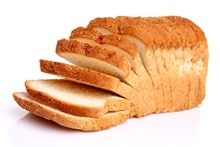
Bread (from wheat)
The global average water footprint of wheat is 1827 litre/kg. About 80% of this amount is allocated to the flour that is derived from the wheat; the rest is attributed to wheat pellets, the by-product. One kilogram of wheat gives about 790 gram of flour, so that the water footprint of wheat flour is about 1850 litre/kg. One kilogram flour gives about 1.15 kg bread, so that the water footprint of bread is 1608 litre/kg. This is a global average; the precise water footprint of bread depends on the origin of the wheat, on where and how it was grown.In western Europe, the water footprint of wheat is far below the global average:
- A French baguette of 300 gram - when baked with French wheat (517 litre/kg) - has a water footprint of 155 litres.
- A German Kaiser-Brötchen of 60 gram - when made with German wheat (690 litre/kg) - has a water footprint of about 40 litres.
- A Dutch bread of 750 gram - when baked with Dutch wheat (610 litre/kg) - costs 460 litres of water. One slice of bread of 30 gram has a water footprint of 18 litres of water.
In the period 1996-2005, global wheat production contributed 15% to the total water footprint of crop production in the world (Mekonnen and Hoekstra, 2010, 2011).
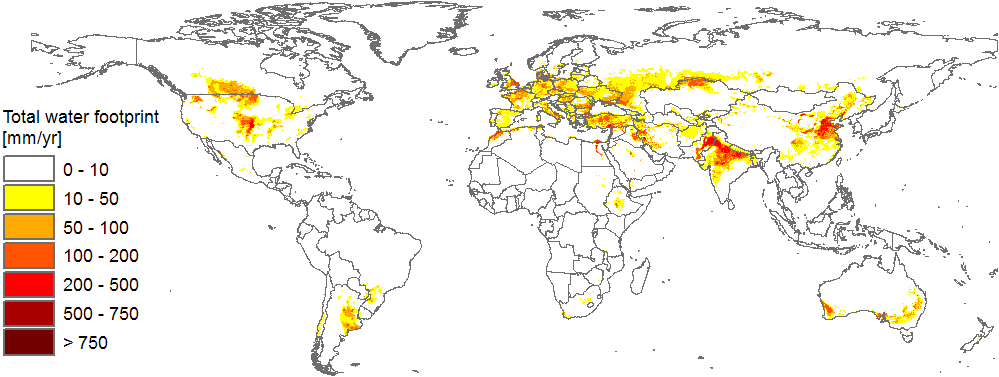
The global water footprint of wheat production. Source: Mekonnen and Hoekstra (2010).
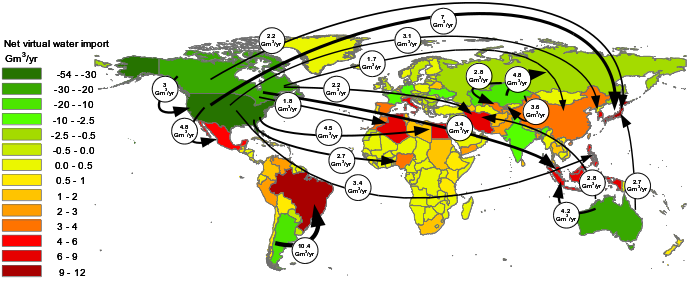
National virtual water balances and net virtual water flows related to trade in wheat products in the period 1996-2005. Only the largest net flows (> 2 Gm3/yr) are shown. Source: Mekonnen and Hoekstra (2010).
Publications
| 2011 | Mekonnen, M.M. and Hoekstra, A.Y. (2011) The green, blue and grey water footprint of crops and derived crop products, Hydrology and Earth System Sciences, 15(5): 1577-1600. | Download 1.2 MB | |
| 2010 | Mekonnen, M.M. and Hoekstra, A.Y. (2010) The green, blue and grey water footprint of crops and derived crop products, Value of Water Research Report Series No.47, UNESCO-IHE. | Main Report Volume 1 | Download 1.2 MB |
| Appendices Volume 2 | Download 9.7 MB | ||
| 2010 | Mekonnen, M.M. and Hoekstra, A.Y. (2010) A global and high-resolution assessment of the green, blue and grey water footprint of wheat, Hydrology and Earth System Sciences, 14(7), 1259-1276. | Download 1.4 MB | |